

Obsession: A Jungian and Existential Analysis
The Existential List #82

A free long-form essay analyzing the themes in the movie Obsession from a Jungian and existential lens? In this economy?
Believe it.
Before we begin, a couple of notes:
Substack has already warned me that this piece is too long for email. So I won’t be further extending it with a synopsis, so if you haven’t seen the movie, I recommend that you watch it or read a detailed synopsis and come back.
I have tried to keep this essay as un-graphic as possible but some elements might be disturbing, especially when analyzed. Know yourself and please proceed mindfully.
Let’s dive in.
In a post-COVID world where going to the movie theatre is not the event it used to be, Obsession might be the most successful film in recent memory. And yes, I say this even with The Odyssey out in theatres as we speak. Obsession has now made almost 633 times its reported $750,000 production budget. For Christopher Nolan’s $250 million epic to match that ratio, it would need to generate an astronomical $158 billion at the box office.
It is safe to say…
People are obsessed with this movie (sorry to pick this very low hanging fruit).
There are, of course, many reasons why this film has achieved the type of cultural capital it has: good plot, entertaining premise, phenomenal acting from a newcomer cast, great pacing and editing. It’s well-made. It’s also luck. Horror is a winning genre right now, and there is something to be said about the right time and the right place. It can also be attributed to the fact that Curry Barker, the young director who’s also a YouTuber, knows how to captivate an audience specifically at a time when attention seems to be an elusive commodity.
But beyond all that, it is smart, relevant and ambiguous enough to allow our own interpretations of it. That is what has allowed it to remain at the centre of so much public discourse even months after its release. Barker has spoken about trusting a modern horror audience to pick up on small details rather than treating viewers like they’re dumb.
The film avoids spoon-fed morality and refuses to force every person into a single interpretation - but this doesn’t mean dissolving every judgement in the waters of relativism. There are some aspects of the narrative that we should be able to agree shows us morally reprehensible behavior.
Which brings me to the point I plan to belabour throughout this piece:
Bear is the villain.
And what makes him a particularly reprehensible villain is that we actually start by rooting for him because he seems like a nice guy. He is soft-spoken, unencumbered by the weight of traditional masculinity, brought into particular relief by his friend Ian, who seems much more like a douchebag dudebro. Bear loved his grandma. His cat died. He is on the unfortunate side of unrequited love. I mean, he has all the typical markings of a sympathetic male protagonist.
But that is precisely the point…
You do not have to be a red-pilled, looksmaxxing Andrew Tate fanboy to be despicable. You can be soft-spoken. You can be a cat-person. You can apologize constantly. You can wear sweaters. You can know the language of boundaries, attachment styles and emotional safety.
And you can still be cruel beyond belief and cowardly when courage matters most.
To understand why, let’s begin with the foreshadowing: Bear’s inability to tell the difference between love and romance.
Love Isn’t The Same As Romance
Near the start of the movie, before he makes the wish and chaos unfurls, Bear is driving Nikki home after trivia night at the bar. They’re talking about the novel Nikki is writing, and Bear calls it a romance. Nikki corrects him and says it’s a love story. Bear can’t tell the difference between the two.
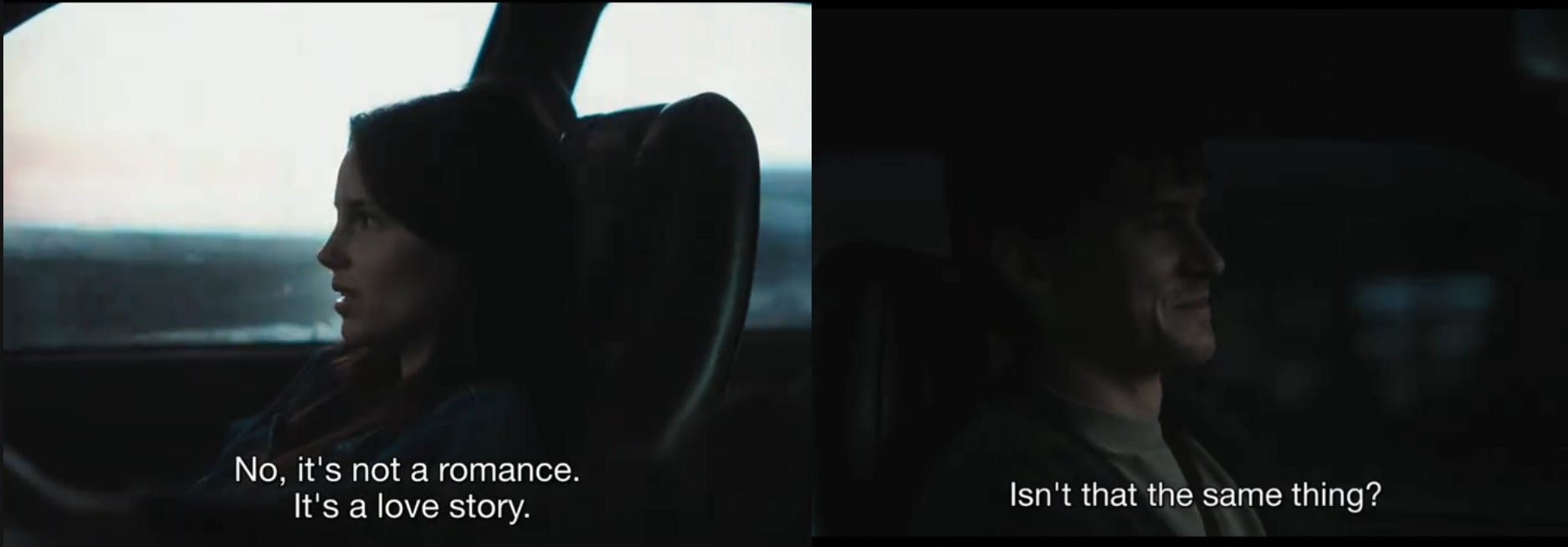
This gives us a revealing insight into how Bear’s psyche has been primed…
As Jungian analyst Robert A. Johnson argues in We: Understanding the Psychology of Romantic Love:
“The fact that we say ‘romance’ when we mean ‘love’ shows us that underneath our language there is a psychological muddle. We are confusing two great psychological systems within us, and this has a devastating effect on our lives and our relationships. The passion of romance is always directed at our own projections, our own expectations, our own fantasies. It is a love not of another person, but of ourselves.”
On the other hand…
“Love is the one power that awakens the ego to the existence of something outside itself, outside its empire, outside its security.”
Love transcends egoism to connect with another.
It is not just a stronger version of romance. It is a fundamentally different psychological ethic.
Romance asks, “What does this person awaken in me?”
Love asks, “Truly who is this person, apart from what I want them to be?”
This is why I believe that Bear never really knew Nikki.
Yes, he knew facts about her. He spent a lot of time with her. They shared jokes, work and went to school together. But knowing information about someone isn’t the same as understanding them as a real person.
The Nikki he thought he knew was his anima projection.
Bear Didn’t Know Nikki
In Jungian psychology, the anima is the unconscious feminine dimension of the psyche. This doesn’t just mean stereotypically “feminine” traits, and it’s not to be reduced to a list like sensitivity, softness or emotionality. The anima is a symbol of inner relatedness, imagination, embodiment and inner guidance.
The anima also represents vitality and soulfulness itself. It is the psychic capacity that makes life feel animated and emotionally connected rather than merely mechanical.
A man who is connected with his anima is able to find meaning, beauty, tenderness, spontaneity and soul within himself. And one who is disconnected from his anima, often projects these traits onto a romantic partner as the magical source of these traits.
Bear is cut off from this vital spirit. His life feels passive, stalled and emotionally stale. He does not know how to meet his longing directly. Instead, everything in him that feels alive, beautiful, desirable, creative and redemptive is projected… onto Nikki.
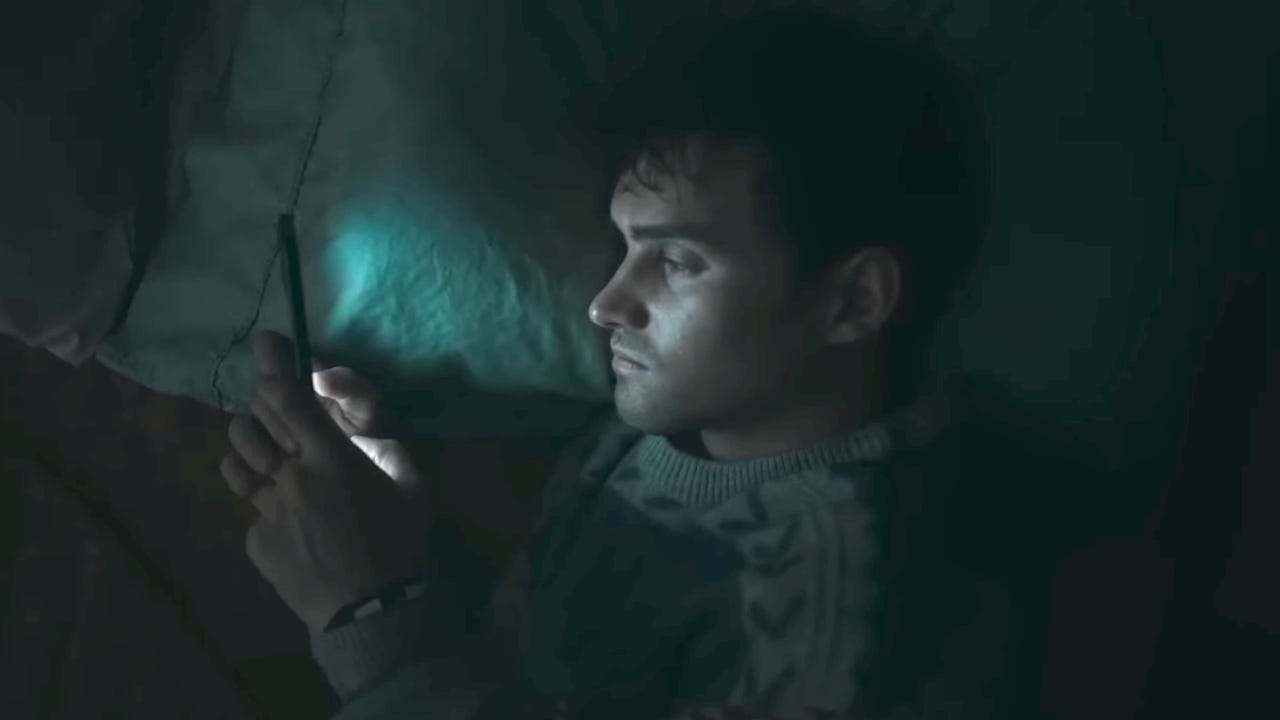
This is why anima projection can feel so overwhelming. The man is not merely attracted to a woman. He is encountering disowned parts of his own soul in the image he has placed onto her. And this image is loaded with psychic material that is split off from Bear himself!
This is not to say that the attraction is fake or that every powerful romantic feeling is “just” projection. Projection is a normal part of how most relationships begin. We all initially fill in what we do not know about another person with hope, fear, memory and fantasy. The problem begins when we refuse to withdraw the projection as the real person becomes more and more visible.
Mature love gradually says: I need to see you more clearly, even if clarity disappoints me.
Bear’s romance, on the other hand says: I need you to remain the fantasy I imagined, even if the real you has to disappear.
Unable to connect with his own anima, Bear projects it onto Nikki and becomes infatuated with his own projection. The real Nikki is effectively still a stranger to him, even as he claims to love her over everything else.
This is common enough. The next part is where it gets pretty disturbing.
Limerence Isn’t Love
Dorothy Tennov’s Love and Limerence gives us the right vocabulary to understand Bear’s projections. Tennov coined the term “limerence” to describe an involuntary state of romantic fixation. Its characterized by intrusive thought, idealization, emotional dependency and an intense longing for reciprocity.
One of Tennov’s most important observations is that uncertainty feeds limerence. Not knowing whether the other person returns your feelings can make the fixation more intense. At some fundamental level, the person stops being a person. They become what Tennov calls the limerent object i.e. the object of the fantasy.
This is why Bear can feel so deeply “in love” with Nikki while remaining so unwilling to discover who she actually is and what she actually feels. The uncertainty hurts him but it also protects his fantasy. As long as he doesn’t ask her out, the imagined Nikki cannot definitively reject him. He can keep interpreting their closeness as evidence that there might be something more…
Some part of Bear knows that the real Nikki cannot match the idealized object of his limerence.
Real intimacy would force him to discover and reckon with Nikki as a real person. This would require her to become a whole human being rather than an idealized image. And that would eventually destroy the fantasy.
Only a wish could freeze-frame the fantasy by transforming the limerent object into its logical conclusion: an obedient body.
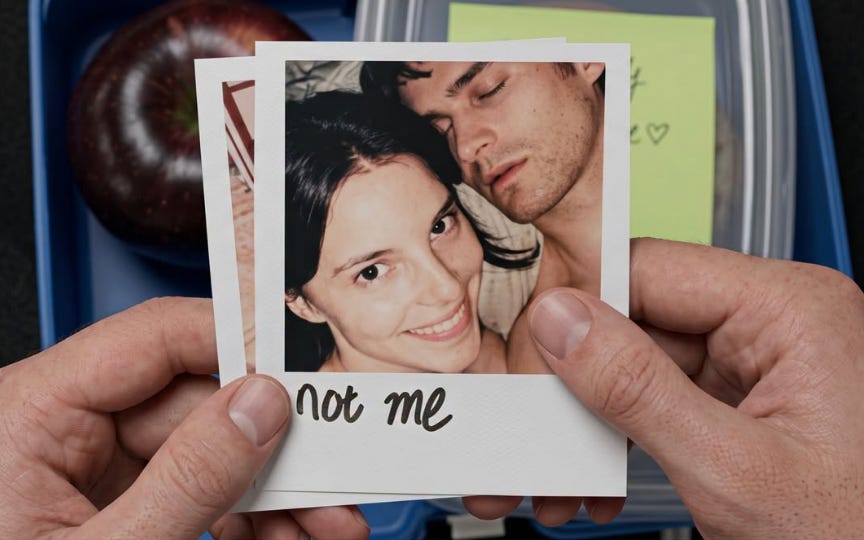
This preserves psychological uncertainty (Nikki’s inner life remains unknowable to Bear), while guaranteeing physical compliance.
An Unhealthy Ego Loves Shortcuts
I’ve said it before and I’ll say it again: the ego itself is not evil. A healthy ego is a necessary tool to navigate reality. It gives us a stable sense of identity, helps us make decisions, protects boundaries and allows us to function in the world. A healthy ego can say “I desire this” while recognizing that desire does not create entitlement. It can survive disappointment.
An unhealthy ego, on the other hand, cannot tolerate the gap between desire and reality. It takes a boundary and rejection as deep humiliation. It needs reality to confirm its preferred story about itself. An unhealthy ego is always looking for an easy hack out of an inconvenient reality.
Bear cannot stand the idea of being rejected by Nikki, so he wishes for reality to bend to his fantasy rather than being courageous and accepting whatever result is meant for him.
Bear is a clear example of what happens when you let the ego rule. It becomes a false god and bad things tend to follow.
Remember, Bear does not just wish for Nikki to love him. He wishes for her to love him more than anyone else in the world.
The inflated ego will settle for nothing less than absolute possession, the full exclusive guarantee against disappointment.
When I made the first iteration of this post on IG last month, a lot of people objected by pointing out that Bear had no idea that the wish would come true, and therefore there’s no reason to think of him as having any negative intent at this stage. I have qualms with this reasoning.
But first, a point I agree with: no, the moment of the wish is not sufficient, in and of itself, to claim that Bear is villainous. Sure, he’s being cowardly and revelling in his insecurities rather than being direct with Nikki, but that’s not malice. And sure the wording of the wish is extreme and absolute, but maybe we can chalk that up to being impulsive and inarticulate.
However, once we have the whole story unfold, we must use that full story to understand Bear’s character and how he had all the ingredients to become despicable. There are direct links between his seemingly innocent actions at this stage, and his deeply unethical actions and omissions later.
I’m going to show you that nothing about Bear’s decision seems surprising when we analyze it in the full context of what actually unfolded. For this we must return, once again, to Carl Jung’s idea of The Shadow.
The Shadow of the ‘Nice Guy’
The Shadow is everything the conscious personality refuses to recognize within itself and disowns from conscious awareness. Because Bear identifies himself as gentle, passive, harmless and nice, he cannot consciously admit that he also wants power.
He doesn’t know himself enough to acknowledge a dark suspicion that he feels entitled to Nikki because he’s nice.
But dark feelings don’t instantly disappear because they’re disowned. They tend to become unconscious and become more likely to pull the strings from the background.
Shadow integration requires us to become conscious of the impulses we disown from consciousness. Only in doing so can we achieve enough awareness to not be puppeteered by these repressed impulses.
Under the right guidance, Bear might admit to himself: “I think part of me believes that being kind should make her choose me. Part of me wants to avoid the humiliation of hearing ‘no’ more than anything else.”
This private admission might be painfully uncomfortable and politically incorrect, but it creates internal honesty and a genuine sense of choice. What is acknowledged within oneself can be examined, restrained and transformed. Bear might even find that the deeper root of his desires isn’t actually Nikki, but the desire for self-esteem and wholeness.
But that’s not what happens…
Bear does the opposite. He denies his shadow, and his shadow starts pulling the strings long before he makes the wish.
For instance, consider when Bear goes to the gift shop to replace the crystal necklace that Nikki loses. He looks at a substitute that Nikki might like, but instead gets her the One Wish Willow, which has nothing to do with her and everything to do with his repressed desires.
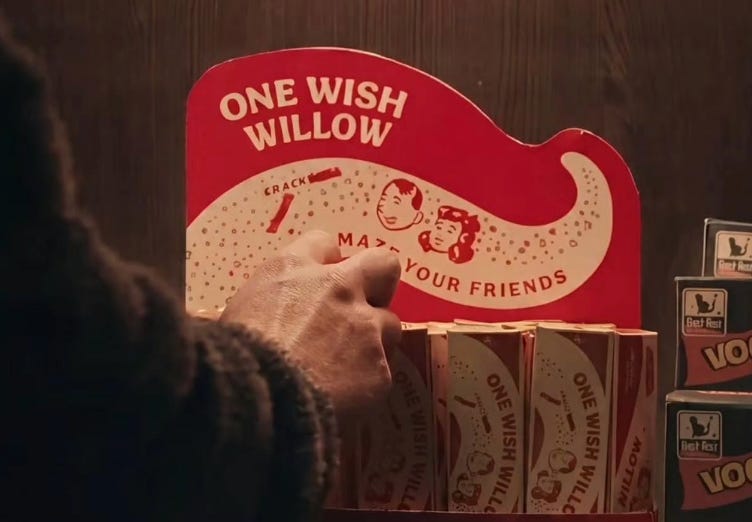
Well before the wish, Bear’s shadow swerves him in the direction of the wish. He’s not operating from malice at this stage, but from lack of self-knowledge and self-trust. He overindexes on Ian’s assessment that Nikki doesn’t like “sappy things”, and defaults to his own unacknowledged wish to be with Nikki. A subtle but significant self-indulgence is already guiding him at this stage.
And then we come to the wish itself…
Far too many people are unquestioningly accepting the premise that the wish was just a harmless expression of Bear’s angst and desire.
Very few people are asking “Wait, but of all the things, why did Bear’s wish necessarily have to be about Nikki?”
Why couldn’t he have asked for more courage to ask her out? Or more courage in general? Or the strength to face his suffering with grace?
Because he lacks the wisdom and inner engagement to see how these are the roots of his problems.
And you might reasonably say: Yepi, these are pretty high level asks. The lad doesn’t know what he doesn’t know, right?
Right, fair, so here’s something more basic…
Why, at the very least, did he not ask for his cat and/or his grandma back?(!)
Because, at some level, these are the mundane, earthly sources of love in his life that don’t cut it for him. They’re easy to take for granted. His vital spirit doesn’t come back if they return. Bear’s anima projection is fully locked onto Nikki. His fantasy of gaining her love is more magnetic than the reality of the actual sources of love he lost.
Every word of the wish is his shadow speaking his selfish, repressed desire into being: “I wish Nikki Freeman would love me more than anyone in the f*cking world.”
And once the wish is granted, it’s only a matter of time before Bear begins his slide into darkness until we reach the two moments which seal his villainy beyond question.
In the restaurant, after it becomes clear to Bear - without a shadow of a doubt - that Nikki is indeed possessed… the very next scene is Bear having sex with Nikki. This is non-consensual and he knows it. Many people are primed to see this scene from Bear’s eyes, but this is precisely the frame that must be challenged. Bear chose to continue the fantasy even after he knew it was a farce. He is deep in villain territory at this point.
And if you take the character implications of that scene seriously, the later scene that’s supposed to be the “true mask-off” moment looks a lot more like the logical end-point of Bear’s character than a sudden heel turn.
I’m of course talking about the scene when Real Nikki finally emerges while Wish Nikki is sleeping. She desperately pleads with Bear to end her misery, and instead of even consoling her, he indignantly asks:
“What would be so bad about being with me?”
It is one of the most evil lines in the film precisely because it is so utterly pathetic and self-involved.
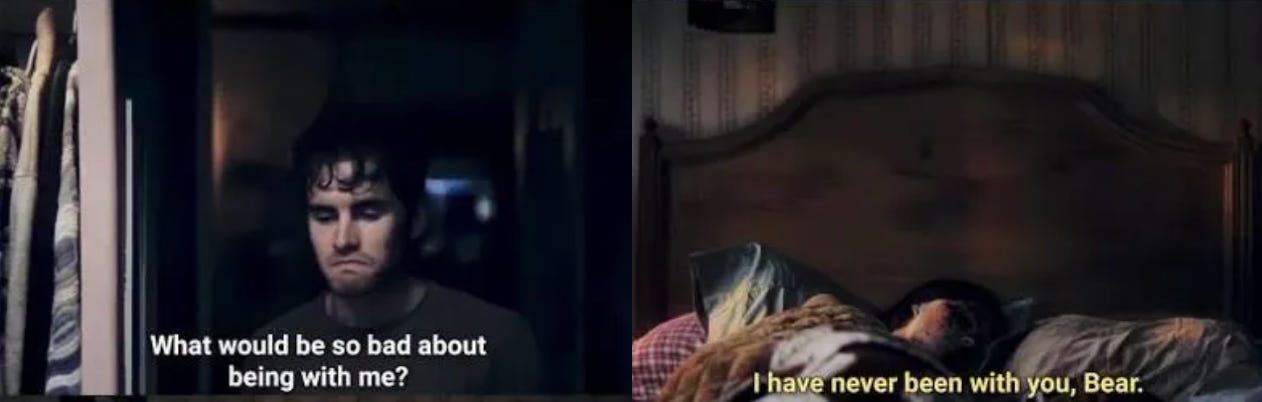
Even as she tells him that she’s been buried alive and desperate to escape her torment, he makes it about himself.
At the very moment when her suffering should destroy his fantasy, his narcissistic injury becomes more important to him than her captivity. He fundamentally still sees himself as the victim.
And then he walks away from her.
We are whisked away from this moment far too quickly in the movie.
Imagine the cruelty of walking away from someone who you know is trapped in hell, who has desperately clawed their way to speak to you, pleading with you to end her misery and you walk away. Someone who you claim you “love.” Bear has become monstrous.
Erich Fromm in The Art of Loving writes that “the main condition for the achievement of love is the overcoming of one’s narcissism.”
He is not using narcissism here as a clinical diagnosis or just a synonym for vanity. He is referring to an orientation in which the individual experiences only his own inner world as fully real while others matter mainly in relation to whether they are useful to him.
That describes Bear’s orientation to a T.
Nikki is useful when she validates him. She is dangerous when she can reject him, even when she is utterly removed from agency and held captive. Her suffering fails to become real to him even when its undeniable and pleading with him. It makes him grow colder.
Real Nikki is met with disdain and malicious apathy.
This confirms that it’s always been about his possession of the limerent object of his fantasy, Wish Nikki, rather than care for Nikki as a real being.
Let’s turn now to what Wish Nikki really is…
The Split Psyche & The Witch
Nikki isn’t possessed by a demon, at least not in a conventional supernatural sense. What happens to her is more real and far worse…
In Jungian psychology, the psyche is made up of many parts. These parts are normally brought into some kind of coherence and unity by a mediating force i.e. The Self. But a cluster of unconscious material can split off from conscious awareness and become what Jung calls a complex. When a complex becomes powerful enough, it can behave almost like an independent personality and even overwhelm conscious awareness.
The wish decenters Nikki’s self and replaces it with an autonomous complex made up of Bear’s desires and projections.
Wish Nikki takes over, submerges the real Nikki into the unconscious and traps her there. Real Nikki can only emerge when Wish Nikki sleeps. She is trapped in a bad dream in the underworld of her own unconscious.
This is also what limerent projection does in real relationships. It makes the subject psychologically invisible. The projector interacts with a limerent object crafted by their imagination and then becomes frustrated when the living person contradicts this fantasy.
In the movie, of course, Bear’s projection does not remain in his own head. It becomes autonomous and begins acting on the world. The fantasy he used to avoid reality now creates a horrific reality.
He is literally haunted by his own desire to possess Nikki.
Wish Nikki can also be seen as one of the darkest archetypal figures: The Devouring Mother or The Witch.
The phrase can sound pretty judgmental if taken literally. That’s why it must be understood in its proper context.
Archetypally, the Devouring Mother is any form of love that refuses separation. She “protects” through imprisonment. She “nurtures” by making independence impossible. She says “You are mine, therefore you must never leave. All separation is evil.” Like a snake devouring its own tail, one’s life force that needs uncertainty to evolve becomes trapped in the sickly comfort of certainty.
Bear doesn’t actually want a partner. Bear is a child who wants a spiritual mother, an outsourced anima figure who will save him from himself.
And that is exactly what he gets, in a perverse way.
He gets an entity that needs him so desperately and violently that it will not stop until it absorbs him fully. This entity experiences all separateness and distance as a threat.
Bear wants unconditional love without the adult burden of mutual recognition and growth through uncertainty. The Devouring Mother is the logical outcome of that wish. It will grant you your wish to remain a child, as long as you promise that you will never leave, never grow, never differentiate…
In this way, Bear’s inflated ego, repressed shadow, and negative anima create the Witch.
Or, at a fundamental level, Bear is the Witch.
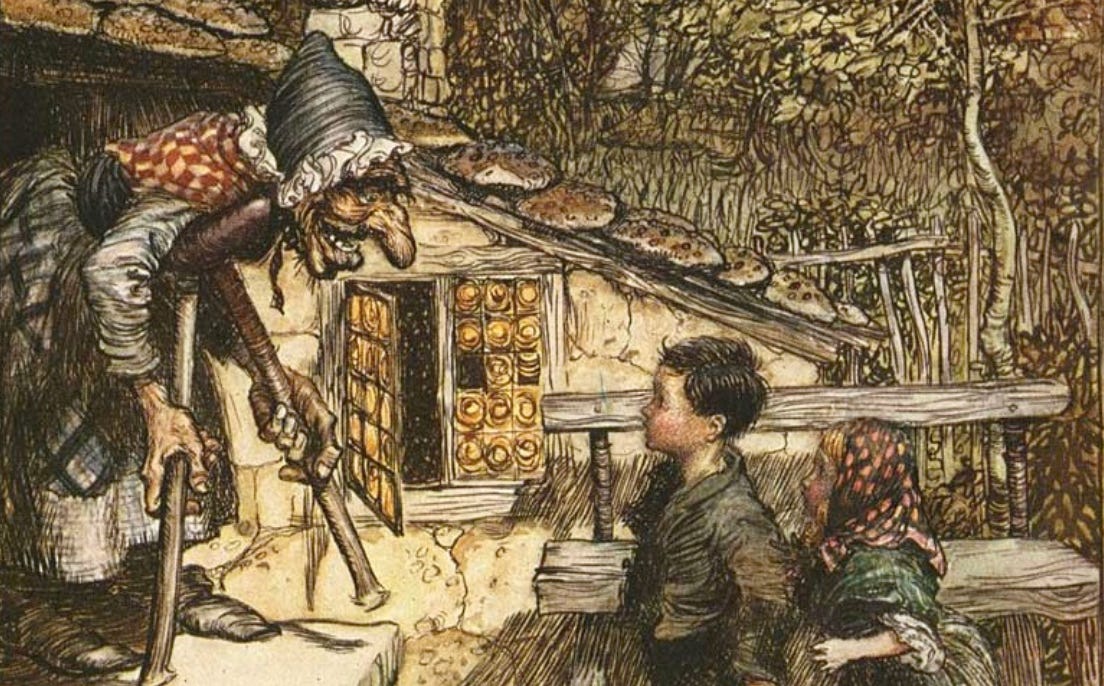
The autonomous complex possessing Nikki is composed of his obsessions and insecurities. Non-Nikki is his unintegrated psyche boomeranged back to him in monstrous form.
This dynamic is the key to understanding the disturbing Hansel and Gretel story Non-Nikki tells at the party.
Before the wish, Nikki saw Bear as a little brother.
(That detail is actually so tragic because it establishes a form of genuine love that Bear refused to value. She cares about him, but not in the form his ego demands.)
Non-Nikki distorts this narrative and eroticizes it. Her version transforms the sibling bond into coercive incestuous possession. Gretel threatens Hansel when he tries to separate from her. The story turns love into selfish hunger. Hansel is not allowed to remain a brother, a separate person or a self. He must become part of Gretel.
In that scene, which I consider the scariest in the movie, Wish Nikki is actively trying to manipulate and break Real Nikki’s version of care for Bear into the perverse script it must follow to satisfy Bear’s selfish fantasy. As the story is told, the last frontier of Real Nikki’s individuality is being broken into conformity.
Bear is still too ego-obsessed to see the consequences of being a child who wishes a witch into existence to become his spiritual mother. He wants someone who can feed every hunger without limit. He fails to remember that the witch in Hansel and Gretel preys on hungry children after luring them in with sweet desire.
The Courage to Be
This brings us back, full circle, to cowardice and courage.
The film is not saying that unrequited love makes a person evil. It’s not saying that loneliness, insecurity or romantic fantasy or even projection makes someone a villain. Those experiences are painfully human.
The evil lies in the repeated refusal to let another person’s reality matter.
Bear has chances to stop.
He can speak honestly before making the wish and risk an answer he does not want.
He can be honest with himself and reject the false relationship when Nikki’s personality changes overnight.
He can respond to Real Nikki’s suffering without making the moment about his wounded self-image.
Again and again, courage is available to him, and again and again he chooses the path that protects his egoic fantasy for one more moment.
This is why the ending deserves attention. When death becomes the only remaining way to end the wish, Bear finally swallows the same pills that accidentally killed his cat. But even then, he panics and tries to reverse his decision.
Outside the bathroom, Wish Nikki uses another One Wish Willow and wishes that Bear will love her back. For a brief moment, he receives the very condition he brought about in Nikki. His freedom is overwritten by somebody else’s desire.
Only then does he love as he demanded to be loved. Only by becoming another obedient body. No more need for discernment or courage, just blind “blissful” conformity.
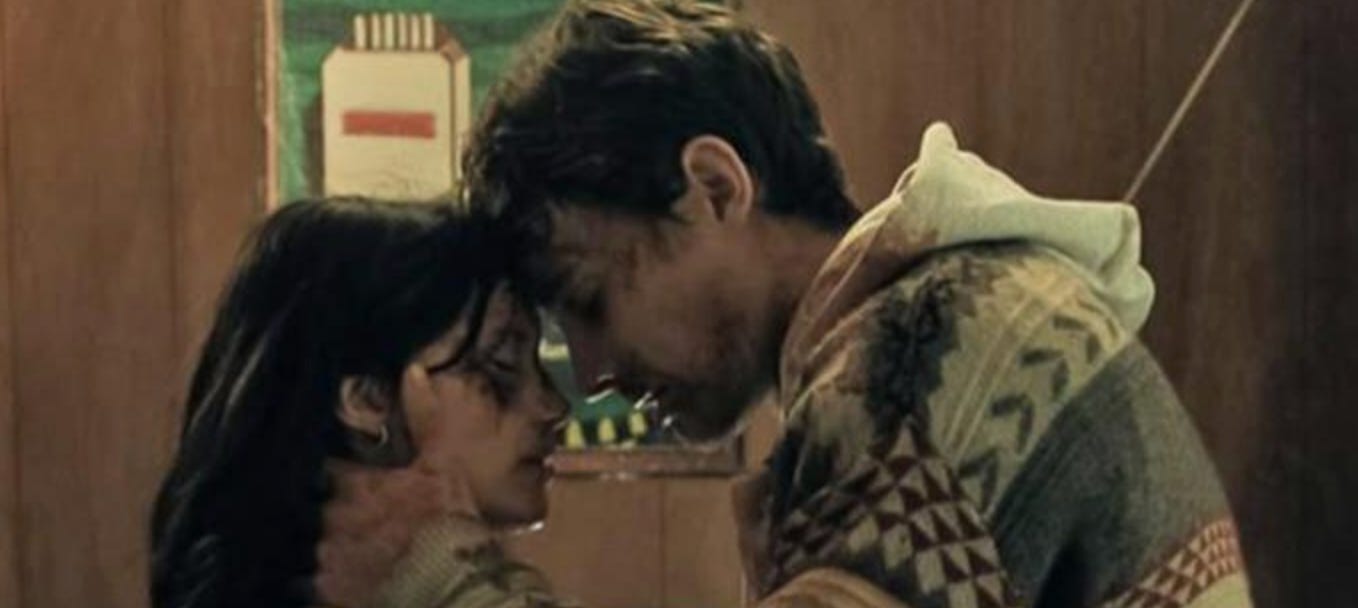
The antidote available to him at all times was courage. Remember the Tiger’s Eye Nikki gifts him? That symbolizes the courage he could’ve and should’ve called on.
The theologian and philosopher Paul Tillich tells us that courage is the core existential value and it comprises “the courage to accept oneself as accepted in spite of being unacceptable.” This is where the transcendent magic lies. It is precisely in the capacity to be rejected without being existentially demolished that we can find the real ground for self-respect as well as compassion for others.
It brings us to eye level with our true selves. Your existence no longer requires validation, because you are infused with the knowledge that you’re able to survive uncertainty, failure and rejection and still persist. Even when you’re faced with the ultimate threat of non-being, you’re able to look it in the eye courageously and affirm life itself.
And funny enough, it is in these states that we are able to truly receive and appreciate the love of another. Not in desperation or scarcity, but in a state of being able to accept the risk of suffering and loss with courage - that is when we have the space for love in our hearts beyond illusion and projection.
All along, Bear could have just thrown the One Wish Willow away, and gone in search for the courage within himself. This would have been the narrower and better path to love.
What Bear’s Cowardice Can Teach Us
The easiest way to watch Obsession is to distance ourselves from Bear. We can say that we would never use a magic wish, never tolerate something so obviously wrong, never become that pathetic. But I think the value of the film is lost if Bear becomes a freak we can all just unthinkingly vanquish.
The harder questions that arise that we could contend with are:
Do I love this person, or do I love how I feel when they validate me?
Can I remain kind when kindness does not get me what I want?
When someone says no, do I experience their boundary as an injury? If so, how deep do I get injured?
Do I want to know who they truly are, or am I seeing them only as the person I hope they will be?
Can I hear that I caused harm without immediately defending myself?
Do I secretly believe that my sensitivity and niceness entitles me to their affection?
Do I use emotional language to become more accountable or to become harder to criticize?
If they never choose me… can I still recognize their freedom as good?
These questions are shadow work in a practical sense, and it helps us develop enough inner life that another person does not have to carry your soul for you.
That is the work of withdrawing the anima projection, especially for men. It means reclaiming the vitality, tenderness, imagination, meaning, and emotional depth we place onto others. By aspiring to wholeness, we expand ourselves and make real space for another.
And that is where love can truly begin.
A Caveat
One can read all this and just say “Or it could just be a movie about a wish gone wrong. Surely all these themes were not intended by the creators of the movie!”
Here’s the thing. There’s no need to claim that Curry Barker consciously placed every Jungian and existential concept into the screenplay or constructed each scene as a coded illustration of these themes. Archetypal readings do not depend on proving authorial intention. Anima, shadow, witches, devouring mothers and forbidden wishes are part of the inherited structure of stories. A good film can activate those patterns without authorial intent.
That said, I did come away with the sense that Curry’s dad Jeff who wrote parts of the movie (and worked as a psychiatric nurse) did have a good grasp of archetypal and existential themes. My ears perked up at the Hansel and Gretel scene (which he wrote) particularly because of how uncannily archetypal and darkly mythopoetic the monologue was.
I felt similarly in the scene where Wish Nikki says this haunting monologue that sounds a lot like deep existential despair:
“Well, if I have the bed all to myself tonight, I’ll lay there warm until slowly I feel cold,
like I walked into a freezer.
My hands will feel like they’re full of sand, like when you lay on them wrong.
And that feeling will slowly spread across my entire body.
You’re still in my heart, but you’re slipping.
Any thought of pain or regret will slip away like a chemical switch.
Even though it’s quiet in the room, somehow it gets even quieter.
It’s not painful.
You just let go of everything you want to work.
And then there’s nothing.
It’s not darkness.
No, sweetie.
Darkness is a color.
There’s just nothing.
…Or you could stay!”
This felt intentional, like a cold fusion of Sylvia Plath and Emil Cioran:
An Invitation
If you enjoyed this piece…
Please subscribe and consider becoming a paid subscriber if you’d like to support my work, which is painstaking and fully human.
Paid subscribers get access to full archives and weekly essays.
Want to learn more about my work and my 1:1 Existential Consulting practice?
References
Robert A. Johnson, We: Understanding the Psychology of Romantic Love (1983)
Dorothy Tennov, Love and Limerence: The Experience of Being in Love (1979)
Erich Fromm, The Art of Loving (1956)
Marie-Louise von Franz, Shadow and Evil in Fairy Tales (1995)
Paul Tillich, The Courage to Be (1952)
This article probably served as an antidote to the film.
This was incredibly insightful, Yepi!